
OPC NEXUS│An OPC Server Comparison Guide for Manufacturing SIs » OPC Server Vendors for Industrial Automation » Yokogawa / Exaopc (CENTUM OPC Server)
Yokogawa / Exaopc (CENTUM OPC Server)
Source: Yokogawa Official website
(https://www.yokogawa.com/in/)
(https://www.yokogawa.com/in/)
Exaopc is Yokogawa's OPC server software for exchanging data between CENTUM production control systems and OPC client applications. It connects directly to CENTUM through Vnet/IP, providing an interface between the control system and applications that use plant data.
For an Indian plant extending its existing CENTUM installation, package selection starts with the receiving application. Identify the interface it requires, then match the Exaopc release to the installed control system and computing environment.
Key Takeaways
- Select the OPC Classic or OPC UA package to match the receiving application's interface.
- Check compatibility by package and release, including the Windows edition and deployment platform.
- Specify the client application when planning redundancy; supported combinations have restrictions.
- Use historical deployments to understand connection roles, then validate the proposed configuration against current specifications.
Exaopc OPC Classic and OPC UA Packages
Source: Yokogawa Official website
(https://www.yokogawa.com/in/library/resources/yokogawa-technical-reports/redundant-opc-server-configured-by-exaopc-rd-virtual-opc-server/)
(https://www.yokogawa.com/in/library/resources/yokogawa-technical-reports/redundant-opc-server-configured-by-exaopc-rd-virtual-opc-server/)
Yokogawa's R3.82 announcement in November 2025 introduced the Exaopc OPC UA Interface Package alongside the existing OPC Interface Package. Choose between them by the required data interface, rather than treating every Exaopc function as available through both packages.
| Package | Documented interfaces and scope |
|---|---|
| Exaopc OPC Interface Package | OPC Classic DA, A&E and HDA, with OPC Security support. Batch functionality is provided through Exaopc/Batch for the specified batch systems and client. |
| Exaopc OPC UA Interface Package | OPC UA Data Access and Alarms & Conditions, as described in the R3.82 release announcement. |
A requirement for historical-data access or batch integration needs a package-specific review. Establish which service the client will call before defining the connection or requesting a quotation.
Source: Yokogawa India
(https://www.yokogawa.com/in/solutions/products-and-services/control/control-and-safety-system/distributed-control-systems-dcs/centum-opc-server-exaopc/)
Source: Yokogawa, Exaopc OPC Interface Package, GS 36J02A10-01E
(https://library.yokogawa.com/document/download/AxkHnJ89/0000005914//EN/)
(https://www.yokogawa.com/in/solutions/products-and-services/control/control-and-safety-system/distributed-control-systems-dcs/centum-opc-server-exaopc/)
Source: Yokogawa, Exaopc OPC Interface Package, GS 36J02A10-01E
(https://library.yokogawa.com/document/download/AxkHnJ89/0000005914//EN/)
Challenges Exaopc Can Help Solve
Sharing CENTUM Data with Plant Information Systems
Yokogawa identifies Exaquantum PIMS and general-purpose OPC applications among Exaopc's connection targets. Projects can use this interface to make CENTUM data available to the selected client.
For a historian or production-information project, define the variables, events and access permissions the application needs. Include whether the connection is for monitoring or also requires approved write access.
Keeping Tag Information in Step with Engineering Changes
The Classic package's equalization function updates function-block information after engineering changes are loaded into the FCS. The client can browse the tag list acquired by Exaopc.
Include representative tag additions and changes in acceptance testing. Verify how the receiving application handles them before using the same approach across the plant.
Managing Data Access Loads on the Control System
Exaopc's documented traffic-control function restricts access volume to avoid exceeding the accessible data rate. This addresses concentrated loads on CENTUM control stations and control buses.
Prepare the requested tag count and acquisition intervals before sizing the connection. Test the combined client workload, including the demand expected after rollout.
Source: Yokogawa India
(https://www.yokogawa.com/in/solutions/products-and-services/control/control-and-safety-system/distributed-control-systems-dcs/centum-opc-server-exaopc/)
(https://www.yokogawa.com/in/solutions/products-and-services/control/control-and-safety-system/distributed-control-systems-dcs/centum-opc-server-exaopc/)
Where Is Exaopc a Good Fit?
Evaluate Exaopc when a project must connect an existing CENTUM system to an OPC-based information application. A plant retaining a Classic client should assess that connection separately from a project introducing a UA client.
Start with an inventory of the installed CENTUM release and receiving applications. For a site with several control-system vendors, map each required connection before deciding whether a CENTUM-focused interface covers the whole project.
Key Specifications and Compatibility
| CENTUM releases in the UA package's November 2025 announcement | CENTUM VP R6.12 and R7.01. Verify the required combination for the proposed installation. |
|---|---|
| Windows environments in that UA announcement | Windows 11 Enterprise LTSC 2024 and Windows Server 2022 Standard. |
| Examples from the Classic R3.82 server OS matrix | Windows 11 Enterprise LTSC 2024 and Windows Server 2022 Standard. Windows Server 2025 Standard requires the R3.82.02 patch. |
| UA certification | Exaopc R3.82.01; Standard 2017 UA Server Profile; certificate 2603CE0126, dated 6 March 2026. |
| Deployment platforms | The R3.82 announcement lists virtualization support for both packages and Dual-redundant Platform for Computer support for the Classic package. |
Windows support depends on the exact edition, release and patch level. The examples above come from different package documents and are not a single shared compatibility list.
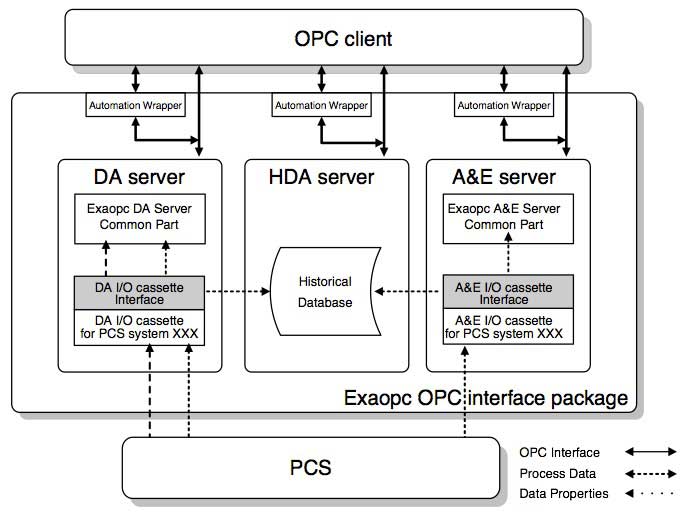
For Classic redundancy, Exaopc-RD monitors two servers and switches the client connection after a failure. The current general specification limits this arrangement to specified Exaopc server models and Exaquantum or Exapilot clients. Confirm the complete server-client combination before including it in a recovery design.
Source: Yokogawa India, CENTUM OPC Server (Exaopc), R3.82 release information
(https://www.yokogawa.com/in/solutions/products-and-services/control/control-and-safety-system/distributed-control-systems-dcs/centum-opc-server-exaopc/)
Source: OPC Foundation, Exaopc product certification history
(https://opcfoundation.org/products/view/exaopc-opc-interface-package/)
(https://www.yokogawa.com/in/solutions/products-and-services/control/control-and-safety-system/distributed-control-systems-dcs/centum-opc-server-exaopc/)
Source: OPC Foundation, Exaopc product certification history
(https://opcfoundation.org/products/view/exaopc-opc-interface-package/)
Deployment Example: Connecting CENTUM to a PI System
Yokogawa's Saudi Aramco Southern Area gas-oil separation plant modernization reference lists an ExaOPC station providing the interface to a PI station in a typical project configuration. The same configuration includes a CENTUM CS 3000 R3 DCS.
The published completion date is 2007. This example demonstrates Exaopc's role in a historical CENTUM-to-PI connection. It predates the new UA package and should be used as a reference for the integration role, with current compatibility established separately.
Source: Yokogawa, Saudi Aramco Southern Area Gas Oil Separation Plant Control System Upgrade Project
(https://www.yokogawa.com/library/resources/references/saudi-aramco-southern-area-gas-oil-separation-plant-control-system-upgrade-project/). The published project completion date is 2007.
(https://www.yokogawa.com/library/resources/references/saudi-aramco-southern-area-gas-oil-separation-plant-control-system-upgrade-project/). The published project completion date is 2007.
Licensing, Evaluation and Support in India
Use the Yokogawa India product page's quotation and technical-support options to discuss a proposed deployment. Provide the CENTUM release, client interface, required data services, tag workload and redundancy plan so the supplier can identify the package and configuration.
Yokogawa's maintenance specification covers both Exaopc packages and requires an Annual Maintenance Contract when covered software licenses are ordered. Software maintenance and on-site system maintenance have different scopes; request a breakdown of licensing, maintenance and commissioning costs.
For evaluation, ask Yokogawa India about an available demonstration or project-specific test. Establish the evaluation conditions and acceptance criteria before scheduling work, including data updates, engineering changes and recovery after a connection loss.
Manufacturer Information
Yokogawa Electric Corporation supplies measurement, control and information solutions for industrial operations. For local product and project enquiries, use Yokogawa India's official sales and support channels.
| Company | Yokogawa Electric Corporation |
|---|---|
| Headquarters | Tokyo, Japan |
| Product | Exaopc / CENTUM OPC Server |
| India product website | https://www.yokogawa.com/in/solutions/products-and-services/control/control-and-safety-system/distributed-control-systems-dcs/centum-opc-server-exaopc/ |
| Sales and technical enquiries | Request a Quote and Technical Support options on the India product page. |
[Advertisement]
OPC Server Products
by Site Requirement
OPC Server Products
by Site Requirement
Advertiser Disclosure:
We receive compensation from some of the companies listed below.This compensation may affect which companies are included and the order in which they appear.
Data Utilization and
Scalable Integration Platform
Scalable Integration Platform

* MQTT and HTTP functions are available in the Professional Edition.
Source: TAKEBISHI CORPORATION official website https://www.faweb.net/en/product/opc , https://www.faweb.net/en/product/opc/v7release
Source: TAKEBISHI CORPORATION official website https://www.faweb.net/en/product/opc , https://www.faweb.net/en/product/opc/v7release
DeviceXPlorer OPC ServerTAKEBISHI CORPORATION
Add or Change Equipment Without Stopping Operation
Communication parameters can be changed dynamically while the server keeps running, so adding a device or revising a setting does not interrupt data collection. Drivers cover 400+ device series from 100+ manufacturers, including Siemens, Rockwell Automation, Mitsubishi Electric and Omron, so most equipment changes are handled as a setting change rather than a rebuild.
One Standard Interface for Upper Systems Across Sites
Every site publishes data through OPC UA, or sends it to AWS, Azure and other cloud services over MQTT or HTTP*, so upper systems see the same interface wherever the data originates. A cloud-side OPC UA client can initiate the connection, so no inbound ports need to be opened at the site. Calculation, conditional branching and recipe handling are configured on the server itself at no additional cost, keeping that work off the SCADA or MES side.
Large-Scale Monitoring
Across Multiple Sites
Across Multiple Sites

Source: PTC official website
https://www.ptc.com/en/products/kepware/kepware-server
https://www.ptc.com/en/products/kepware/kepware-server
Kepware ServerVelotic (Kepware, formerly a PTC business)
Designed for Multi-Site Expansion
Packaged licensing* for large-scale standardization reduces the need to procure licenses when adding new sites or manage updates site by site. This supports scaling while maintaining the management framework.
Remote Management
and Configuration
and Configuration
With add-on options, OPC servers running at different sites can be centrally managed from the main site.
Audit Readiness for Plant Operations
Source: Honeywell official website
https://www.matrikonopc.com/index.aspx
https://www.matrikonopc.com/index.aspx
MatrikonOPC ServerHoneywell
Integrate Field Data
into the Monitoring Network
into the Monitoring Network
Collects oil and gas drilling data via OPC. Secure transmission across firewalls and redundancy help maintain an audit-ready data foundation over time.
Quickly Check Who Did What,
and When
and When
All servers include diagnostic logging with log-level settings and filtering. The logs can also serve as a foundation for audit trails.
*Purchasing Site & Enterprise licenses requires an inquiry to
Velotic.