
OPC NEXUS│An OPC Server Comparison Guide for Manufacturing SIs » How to Choose an OPC Server
How to Choose an OPC Server
INDEX
View All
In India, multi-vendor environments with European, Japanese, and U.S. equipment are common. Introducing an OPC server that does not fit your site can increase the risk of data loss or line stoppages. To help you avoid these risks, this article outlines how to choose an OPC server.
Key Points to Check When Choosing an OPC Server
for Manufacturing Sites in India
Connectivity and Scalability
The first point to check is whether the OPC server can provide stable connectivity with your existing PLCs and equipment. Check whether it supports equipment from major manufacturers such as Siemens, Rockwell, Mitsubishi, and Schneider, as well as communication standards such as EtherNet/IP, Modbus, PROFINET, and OPC UA.
You should also check scalability, including whether CNC machines, power meters, and other devices can be added flexibly in the future.
Reliability, Security, and Operational Continuity
Stable operation of the OPC server is also an important point. Check whether it can maintain performance as the number of tags and communication volume increase, and whether it supports redundancy and recovery in the event of a failure.
Security features such as authentication and encryption, as well as support for OPC UA, are also important. Comparing whether each configuration supports safe, continuous operation while reducing the risk of site stoppages can help prevent problems after deployment.
Support, Licensing, and Ease of Future Migration
With post-deployment operations in mind, check the support structure and licensing model, including whether it is based on the number of devices or tags. It is important to understand the availability of technical support and how costs may increase, then choose a solution that also takes migration from legacy environments and future OPC UA support into account.
OPC-Related Products Commonly Compared in India
This section explains the differences among OPC-related products that are often compared.
Differences Between Kepware Server and Matrikon OPC Products
Kepware Server is a single large connectivity platform, while Matrikon OPC Products is a product family with products organized by use case and conversion type. The right choice depends on whether you prioritize connectivity or analysis. The following article compares the two solutions in terms of license structure, cost, and support for multi-vendor environments.
Role Differences Between Kepware Server and ThingWorx
The difference between the two lies in their roles. Kepware Server is a connectivity platform for linking PLCs, equipment, and upper-level systems. ThingWorx is an IIoT platform for using data through visualization, analysis, and other applications. The product you choose depends on which role you prioritize. The following article summarizes the differences and key selection points in detail.
By Use Case: Quick Selection Guide
Check the selection criteria that matter most based on the case closest to your site’s challenges.
Large-Scale Multi-Vendor Integration
For large sites with equipment from multiple manufacturers, a product that can standardize connectivity design is recommended. Focus on the range of supported equipment and communication standards, ease of setup and operation when adding equipment, and whether connectivity methods can be standardized. The TOP page below introduces Kepware Server, which helps centralize management across multiple sites.
Legacy Migration and High-Reliability Integration
If you want to make use of an OPC Classic environment or legacy equipment, focus on maintaining connectivity with existing equipment while also considering ease of future migration to OPC UA. At the same time, check whether the product can support stable operation while reducing the risk of stoppages, and whether it is easy to monitor and maintain. The article below introduces Matrikon OPC Products for sites that prioritize migration from legacy environments.
Legacy Environments with a Mix of Japanese-Made PLCs
If your site runs on a legacy environment with PLCs from multiple manufacturers, including Japanese brands accumulated over years of equipment additions and replacements, compatibility across PLC generations and brands becomes a key concern.
For sites that need to add or change equipment without stopping production lines, DeviceXPlorer from Takebishi Corporation is introduced below. It supports connectivity with many devices, including older and mixed-generation PLCs from Japanese and other manufacturers, and includes hot configuration functionality.
OPC Server Products
by Site Requirement
by Site Requirement
Data Utilization and
Scalable Integration Platform
Scalable Integration Platform

* MQTT and HTTP functions are available in the Professional Edition.
Source: TAKEBISHI CORPORATION official website https://www.faweb.net/en/product/opc , https://www.faweb.net/en/product/opc/v7release
Source: TAKEBISHI CORPORATION official website https://www.faweb.net/en/product/opc , https://www.faweb.net/en/product/opc/v7release
DeviceXPlorer OPC ServerTAKEBISHI CORPORATION
Add or Change Equipment Without Stopping Operation
Communication parameters can be changed dynamically while the server keeps running, so adding a device or revising a setting does not interrupt data collection. Drivers cover 400+ device series from 100+ manufacturers, including Siemens, Rockwell Automation, Mitsubishi Electric and Omron, so most equipment changes are handled as a setting change rather than a rebuild.
One Standard Interface for Upper Systems Across Sites
Every site publishes data through OPC UA, or sends it to AWS, Azure and other cloud services over MQTT or HTTP*, so upper systems see the same interface wherever the data originates. A cloud-side OPC UA client can initiate the connection, so no inbound ports need to be opened at the site. Calculation, conditional branching and recipe handling are configured on the server itself at no additional cost, keeping that work off the SCADA or MES side.
Large-Scale Monitoring
Across Multiple Sites
Across Multiple Sites

Source: PTC official website
https://www.ptc.com/en/products/kepware/kepware-server
https://www.ptc.com/en/products/kepware/kepware-server
Kepware ServerVelotic (Kepware, formerly a PTC business)
Designed for Multi-Site Expansion
Packaged licensing* for large-scale standardization reduces the need to procure licenses when adding new sites or manage updates site by site. This supports scaling while maintaining the management framework.
Remote Management
and Configuration
and Configuration
With add-on options, OPC servers running at different sites can be centrally managed from the main site.
Audit Readiness for Plant Operations
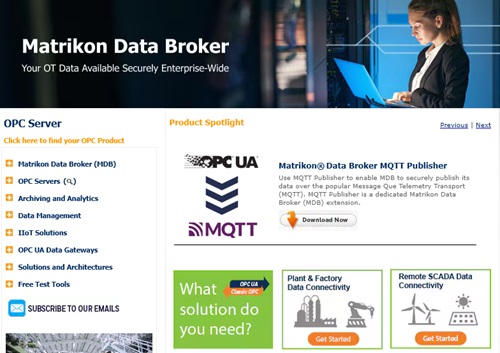
Source: Honeywell official website
https://www.matrikonopc.com/index.aspx
https://www.matrikonopc.com/index.aspx
MatrikonOPC ServerHoneywell
Integrate Field Data
into the Monitoring Network
into the Monitoring Network
Collects oil and gas drilling data via OPC. Secure transmission across firewalls and redundancy help maintain an audit-ready data foundation over time.
Quickly Check Who Did What,
and When
and When
All servers include diagnostic logging with log-level settings and filtering. The logs can also serve as a foundation for audit trails.
*Purchasing Site & Enterprise licenses requires an inquiry to
Velotic.