
OPC NEXUS│An OPC Server Comparison Guide for Manufacturing SIs » Choose By Industry
Choose By Industry
INDEX
View All
This article organizes manufacturing data integration challenges that differ by industry and explains how OPC servers work as a connectivity foundation, based on industry-specific use cases.
Automation Barriers Facing Manufacturing Sites in India
Even as equipment automation advances, the data foundation needed to use that data does not always keep pace. Mixed-vendor equipment environments, continued use of legacy equipment, and systems not connected to the cloud are common bottlenecks at many sites. However, where these issues tend to appear in the process differs by industry.
Common OPC Server Use Patterns Across Industries
Consolidating and Visualizing Equipment Data
To use scattered equipment data across SCADA and MES, you first need to consolidate and standardize that data. The OPC server handles that preprocessing role, putting the prerequisites for visualization in place.
One Connection Point for Multi-Vendor Equipment
A single OPC server can connect equipment from different vendors, including Mitsubishi, OMRON, and Siemens. It absorbs protocol differences, making unified data acquisition for upper-level systems possible.
Linking Data to the Cloud and Analytics Platforms
An OPC server does not perform predictive maintenance or quality improvement analysis itself; rather, it serves as the bridge that delivers usable data to the cloud or an analytics platform. With the data foundation in place, upper-level systems have more room to add value.
By Industry: What an OPC Server Can Solve
Automotive Manufacturing: Unified Visibility Across the Line
An OPC server helps solve the challenge of monitoring the entire line across processes by bridging data fragmented by process. On production lines where robots, PLCs, inspection systems, and other equipment run different protocols, an OPC server standardizes and collects data from each piece of equipment. Operating status can then be viewed centrally in SCADA or MES.
Automotive Parts Manufacturing: Real-Time Data Collection by Process
In parts manufacturing, where delivery and quality requirements are strict, operating records often remain dispersed by process and are not integrated with upper-level systems. By collecting PLC data in real time through an OPC server, you can strengthen traceability and automatically link delivery quality records to upper-level systems.
Semiconductor Manufacturing: High-Precision Data and History Management
In semiconductor manufacturing, where quality requirements are high, detailed equipment data is often not collected or stored sufficiently, making process tracking and root-cause investigation difficult. By continuously collecting and storing fine-grained data with an OPC server, you can establish a foundation for traceability and quality management.
Process Industries: Continuous Monitoring and Early Detection of Anomalies
In process industries, where downtime costs are especially high, a system that continuously monitors the status of equipment running around the clock is essential. Collecting equipment status in real time with an OPC server helps detect anomalies early.
Food and Beverage Manufacturing: Visibility into Changeover and Downtime Factors
An OPC server helps solve the challenge of identifying bottlenecks across the entire line when equipment is managed separately. An OPC server collects equipment data across packaging, filling, and conveying lines. This supports clearer visibility into changeover and downtime factors.
OPC Server FAQ
Q. Can We Adopt Industry 4.0 Without Replacing Existing Equipment?
In some cases, yes. Because an OPC server can connect to existing PLCs and CNCs and bridge data to upper-level systems or the cloud, you can move toward Industry 4.0 step by step without a full equipment replacement. However, you still need to confirm supported protocols and the network configuration.
Q. Can One OPC Server Handle Equipment from Multiple Vendors?
Yes, it can. If the OPC server supports multiple protocols, equipment from different vendors can be connected through a single server.
Q. Which Industries Use OPC Servers?
OPC servers are used in industries that need to connect different equipment with upper-level systems, including automotive, automotive parts, semiconductors, food and beverage, and process industries. They are especially well suited to mixed-vendor environments and sites that want to make the most of existing equipment.
Choosing the Right OPC Server Product
The right OPC server and required specifications vary depending on the nature of the smart manufacturing project, including high-mix, low-volume changeovers, multi-site integration, audit readiness, and regulatory compliance. The article below features selected OPC server products by project type, each suited to solving specific challenges. Please use it for comparison and evaluation.
OPC Server Products
by Site Requirement
by Site Requirement
Data Utilization and
Scalable Integration Platform
Scalable Integration Platform

* MQTT and HTTP functions are available in the Professional Edition.
Source: TAKEBISHI CORPORATION official website https://www.faweb.net/en/product/opc , https://www.faweb.net/en/product/opc/v7release
Source: TAKEBISHI CORPORATION official website https://www.faweb.net/en/product/opc , https://www.faweb.net/en/product/opc/v7release
DeviceXPlorer OPC ServerTAKEBISHI CORPORATION
Add or Change Equipment Without Stopping Operation
Communication parameters can be changed dynamically while the server keeps running, so adding a device or revising a setting does not interrupt data collection. Drivers cover 400+ device series from 100+ manufacturers, including Siemens, Rockwell Automation, Mitsubishi Electric and Omron, so most equipment changes are handled as a setting change rather than a rebuild.
One Standard Interface for Upper Systems Across Sites
Every site publishes data through OPC UA, or sends it to AWS, Azure and other cloud services over MQTT or HTTP*, so upper systems see the same interface wherever the data originates. A cloud-side OPC UA client can initiate the connection, so no inbound ports need to be opened at the site. Calculation, conditional branching and recipe handling are configured on the server itself at no additional cost, keeping that work off the SCADA or MES side.
Large-Scale Monitoring
Across Multiple Sites
Across Multiple Sites

Source: PTC official website
https://www.ptc.com/en/products/kepware/kepware-server
https://www.ptc.com/en/products/kepware/kepware-server
Kepware ServerVelotic (Kepware, formerly a PTC business)
Designed for Multi-Site Expansion
Packaged licensing* for large-scale standardization reduces the need to procure licenses when adding new sites or manage updates site by site. This supports scaling while maintaining the management framework.
Remote Management
and Configuration
and Configuration
With add-on options, OPC servers running at different sites can be centrally managed from the main site.
Audit Readiness for Plant Operations
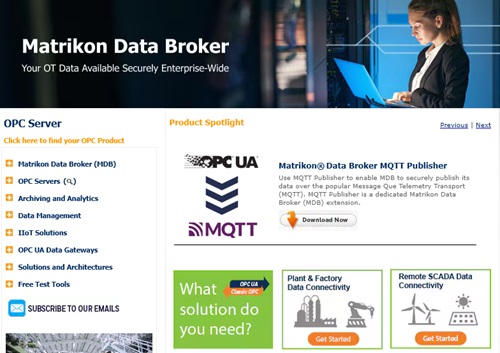
Source: Honeywell official website
https://www.matrikonopc.com/index.aspx
https://www.matrikonopc.com/index.aspx
MatrikonOPC ServerHoneywell
Integrate Field Data
into the Monitoring Network
into the Monitoring Network
Collects oil and gas drilling data via OPC. Secure transmission across firewalls and redundancy help maintain an audit-ready data foundation over time.
Quickly Check Who Did What,
and When
and When
All servers include diagnostic logging with log-level settings and filtering. The logs can also serve as a foundation for audit trails.
*Purchasing Site & Enterprise licenses requires an inquiry to
Velotic.