
OPC NEXUS│An OPC Server Comparison Guide for Manufacturing SIs » OPC Server Vendors for Industrial Automation » TAKEBISHI CORPORATION / DeviceXPlorer OPC Server
TAKEBISHI CORPORATION / DeviceXPlorer OPC Server
INDEX
View All
This article explains DeviceXPlorer OPC Server from TAKEBISHI CORPORATION, industrial communication software with a cumulative total of more than 62,000 installations across 76 countries (as of April 2026).

Source: TAKEBISHI CORPORATION Official Website
(https://www.faweb.net/en/product/opc/)
(https://www.faweb.net/en/product/opc/)
Challenges DeviceXPlorer OPC Server Can Help Solve
Helps Reduce Operational Workload at Sites
with Frequent Equipment Additions
and Setting Changes
Because devices can be added, tag settings can be changed, and communication parameters can be adjusted even while the line is running, sites do not need to assume major rebuilds or external modifications every time equipment is added. At Indian sites where lines are expected to run 24 hours a day and fine-tuning after startup is common, this can help reduce adjustments that require downtime.
Helps Make Use of Existing Equipment
and Legacy Environments
DeviceXPlorer OPC Server includes scripting functions that allow calculations and conditional branching on the server side. Data formatting and branching logic can be configured by product type on the OPC server side, helping reduce the workload for changeovers and data collection rule changes while keeping existing equipment in use. It helps introduce data utilization without requiring new capital investment in equipment.
Helps Standardize Connections to Upper-Level Systems Across Global and Japanese Controllers
DeviceXPlorer OPC Server comes standard with drivers that can access control devices from more than 400 series and over 100 vendors*1, covering Siemens and Rockwell Automation controllers alongside models from Japanese manufacturers. Even at sites where imported and Japanese-made equipment run side by side, this product helps standardize the connection interface on the upper-system side. It can reduce the workload required to build individual connections for each device.
*1 Source: TAKEBISHI CORPORATION Official Website | Information confirmed on the official website as of April 2026 [PDF] (https://www.takebishi.co.jp/static/files/downloads/original_production_catalog.pdf)
What Types of Sites Is DeviceXPlorer OPC Server Suitable For?
Legacy Contract Manufacturing Lines
with Mixed-Generation, Multi-Vendor Equipment
Given its broad model support and ease of setting changes, DeviceXPlorer OPC Server is well suited to manufacturing plants with a mix of equipment from different generations and vendors, including Siemens and Rockwell Automation controllers alongside Japanese-made PLCs. The product helps reduce the implementation and modification workload that often comes with product changeovers or equipment additions, making it easier to introduce data utilization even at sites that combine U.S. and European SCADA systems with Japanese-made PLCs.
Project challenges differ, from high-mix production where product changeovers are an issue to multi-site integration, audit readiness, and regulatory compliance. The article below features selected OPC server products by need, each with specifications suited to solving specific challenges. Please use it for comparison and evaluation.
Key Specifications
of DeviceXPlorer OPC Server
| Supported Protocols: | OPC UA 1.04 / OPC DA 3.0, 2.05A / OPC AE 1.10 / SuiteLink / DxpLink (TAKEBISHI proprietary) / HTTP / HTTPS / MQTT(S) / Modbus / TCP server |
|---|---|
| Pricing Guide and Fee Structure: | Contact for details |
Supported Devices
and Connection Targets:
DeviceXPlorer OPC Server comes with standard drivers for controllers from major global manufacturers, including Siemens (SIMATIC) and Rockwell Automation (Allen-Bradley), as well as GE, LSIS and Saia. It also covers Japanese-made PLCs in depth, including Mitsubishi Electric (MELSEC), Omron (SYSMAC), YOKOGAWA (FA-M3) and JTEKT (TOYOPUC), together with CNC systems and industrial robots. This combination makes it easier to consolidate connections between U.S. and European SCADA systems and upper-level MES or ERP systems through a single OPC server. It also supports OPC UA and can function as a standard connection interface with upper-level systems.
Source: TAKEBISHI official website (https://www.faweb.net/en/product/opc/plc/) | Information confirmed as of September 2026
Supported Functions
and Scope of Use:
Beyond data collection, processing, calculation, and branching logic can be configured on the OPC server side using the Lua script engine. The Professional edition also supports MQTT and HTTP integration, making it easier to connect to cloud platforms such as AWS and Azure.
Implementation Requirements
and Pricing Structure:
You can select a license that matches your implementation environment and budget. The Single edition is a perpetual license suited to projects that want to run a PoC with one device model. The Multi edition is a perpetual license suited to lines with a mix of devices from multiple vendors. The Professional edition is available as both a perpetual license and a subscription, and is suited to projects with stronger upper-level integration requirements.
DeviceXPlorer OPC Server Case Study
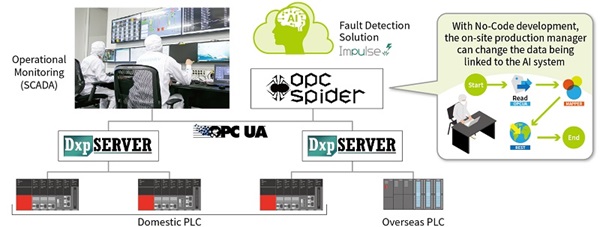
Suntory Products: No-Code AI Integration for More Than 80 Multi-Vendor PLCs
Source: TAKEBISHI CORPORATION Official Website
(https://www.faweb.net/en/solution/successstory/suntoryproducts)
(https://www.faweb.net/en/solution/successstory/suntoryproducts)
Challenges Before Implementation
This case study covers the Suntory Kita Alps Shinano-no-Mori Water Plant, which began operations as a next-generation factory model. While planning real-time monitoring using an AI anomaly detection system, the plant faced the challenge of a mix of approximately 80 PLCs from different vendors and countries of origin. The plant needed to build a data integration platform that could efficiently collect data from a wide variety of devices and deliver it to the AI system.
Outcome After Implementation
By implementing DeviceXPlorer, factory-floor personnel could specify the necessary data from 80 PLCs and complete the settings to send it to the AI system using only mouse operations through the GUI. Because staff can add and test settings on the same day they decide, “Let’s add data from this equipment to the AI training as well,” the accuracy of equipment maintenance has improved.
Source: TAKEBISHI CORPORATION Official Website (https://www.faweb.net/en/solution/successstory/suntoryproducts)
Fit with Indian Manufacturing, as Seen in the Case Study
Because DeviceXPlorer OPC Server can integrate a wide range of existing equipment into OPC UA on a single platform, it is a strong fit for Indian manufacturing. A configuration with “80 devices from multiple vendors” is similar to environments such as automotive plants in Chennai and parts suppliers in Pune, where equipment has been added repeatedly.
Is a DeviceXPlorer OPC Server Trial or Demo Available?
You can download a free demo version that can be used continuously for three hours (DeviceXPlorer OPC Server V7)*3 from the official website. If continuous operation beyond the demo period is required for implementation verification, a one-month evaluation license*4 is provided, allowing you to verify communication stability and ease of configuration in advance.
*3 Source: TAKEBISHI CORPORATION Official Website (https://www.faweb.net/en/download/download/)
*4 Source: TAKEBISHI CORPORATION Official Website (https://www.faweb.net/faq/detail/172)
Manufacturer Information
TAKEBISHI CORPORATION is a Japanese technical trading company and manufacturer founded in 1926. It is a distributor for Mitsubishi Electric and an early member of the OPC Foundation, which develops the OPC UA standard.
| Company Name | TAKEBISHI CORPORATION |
|---|---|
| Headquarters Address | 29 Mameda-cho, Nishikyogoku, Ukyo-ku, Kyoto 615-8501, JAPAN |
| India Office | [Mitsubishi Electric India Pvt. Ltd.] ICC-Devi Gaurav Technology Park, Unit No. 402, Fourth Floor, Survey No. 191-192 (P), Opp. Vallabh Nagar Bus Depot, Pune – 411018, Maharashtra, India [Agrem Technosol Pvt. Ltd.] 83 A, GIDC Por, Vadodara, Gujarat, India, PIN 391243 |
| Official Website | https://www.faweb.net/en/ https://mitsubishielectric.in/contact-us |
OPC Server Products
by Site Requirement
by Site Requirement
Data Utilization and
Scalable Integration Platform
Scalable Integration Platform

* MQTT and HTTP functions are available in the Professional Edition.
Source: TAKEBISHI CORPORATION official website https://www.faweb.net/en/product/opc , https://www.faweb.net/en/product/opc/v7release
Source: TAKEBISHI CORPORATION official website https://www.faweb.net/en/product/opc , https://www.faweb.net/en/product/opc/v7release
DeviceXPlorer OPC ServerTAKEBISHI CORPORATION
Add or Change Equipment Without Stopping Operation
Communication parameters can be changed dynamically while the server keeps running, so adding a device or revising a setting does not interrupt data collection. Drivers cover 400+ device series from 100+ manufacturers, including Siemens, Rockwell Automation, Mitsubishi Electric and Omron, so most equipment changes are handled as a setting change rather than a rebuild.
One Standard Interface for Upper Systems Across Sites
Every site publishes data through OPC UA, or sends it to AWS, Azure and other cloud services over MQTT or HTTP*, so upper systems see the same interface wherever the data originates. A cloud-side OPC UA client can initiate the connection, so no inbound ports need to be opened at the site. Calculation, conditional branching and recipe handling are configured on the server itself at no additional cost, keeping that work off the SCADA or MES side.
Large-Scale Monitoring
Across Multiple Sites
Across Multiple Sites

Source: PTC official website
https://www.ptc.com/en/products/kepware/kepware-server
https://www.ptc.com/en/products/kepware/kepware-server
Kepware ServerVelotic (Kepware, formerly a PTC business)
Designed for Multi-Site Expansion
Packaged licensing* for large-scale standardization reduces the need to procure licenses when adding new sites or manage updates site by site. This supports scaling while maintaining the management framework.
Remote Management
and Configuration
and Configuration
With add-on options, OPC servers running at different sites can be centrally managed from the main site.
Audit Readiness for Plant Operations
Source: Honeywell official website
https://www.matrikonopc.com/index.aspx
https://www.matrikonopc.com/index.aspx
MatrikonOPC ServerHoneywell
Integrate Field Data
into the Monitoring Network
into the Monitoring Network
Collects oil and gas drilling data via OPC. Secure transmission across firewalls and redundancy help maintain an audit-ready data foundation over time.
Quickly Check Who Did What,
and When
and When
All servers include diagnostic logging with log-level settings and filtering. The logs can also serve as a foundation for audit trails.
*Purchasing Site & Enterprise licenses requires an inquiry to
Velotic.