
OPC NEXUS│An OPC Server Comparison Guide for Manufacturing SIs » OPC Standards Glossary
OPC Standards Glossary
INDEX
View All
This glossary organizes terms often used in manufacturing digital transformation, such as OPC, OPC UA, and Modbus/TCP. It gives you an overview of what can change when these technologies are introduced.
Key OPC Terms, Defined
OPC
OPC is a communication standard that creates a common language between equipment and software from different manufacturers, enabling smooth information exchange. It is a standard, not a product name. OPC can reduce the need to develop dedicated communication programs for each manufacturer.
OPC UA
OPC UA is a next-generation OPC standard that builds on and streamlines the earlier OPC Classic specifications. It runs independently of Windows or any specific platform, making it easier to use across a wide range of equipment and systems. With security features such as authentication and encryption, as well as strong scalability, it is widely used in modern manufacturing sites.
OPC DA
OPC DA is an older-generation standard specialized for real-time data collection. Unlike OPC UA, it runs on Windows COM/DCOM, so some sites still use it to connect existing SCADA systems and older equipment.
While new deployments have largely shifted to OPC UA, OPC DA remains an important term to understand when reviewing or migrating existing systems.
OPC AE
OPC AE is a standard focused on alarm and event management. Unlike OPC DA, which collects real-time data, OPC AE is used to handle equipment fault notifications and status-change messages. It is now being integrated into OPC UA, but it remains an important term when working with existing monitoring systems and operations management.
MQTT
MQTT is a communication protocol for sending data with minimal overhead. Because it uses a publish/subscribe model, it makes flexible data distribution easier for the parties that need the data.
OPC UA and MQTT are often used together based on their strengths: OPC UA for adding meaning to and modeling equipment data, and MQTT for remote distribution and cloud transfer, as in OPC UA over MQTT.
Modbus/TCP
Modbus/TCP is an industrial network standard widely adopted for communication with older equipment. It is not the same type of standard as OPC. In practice, sites often collect equipment data through Modbus/TCP and pass it to upper-level systems through an OPC server. It is a relevant term for sites that want to move forward with digital transformation while keeping legacy equipment in operation.
How OPC Adoption Changes Manufacturing Sites
This section looks at what changes at manufacturing sites from three perspectives: data integration, security, and making use of existing assets.
Efficient Data Integration
Data from PLCs, CNCs, sensors, and other equipment can be linked more easily to upper-level systems, including MES and SCADA, through a standardized interface. This reduces the need to prepare separate communication programs and helps standardize connection design, even at sites with equipment from multiple manufacturers.
Balancing Productivity and Security
Because application authentication, encryption, and secure channels are built into the design of OPC UA, it also helps strengthen security.
For the digital transformation initiatives increasingly required in manufacturing, secure data management becomes more important as the scope of connectivity expands. Support for OPC UA is not simply a trend; it provides a foundation for external connectivity and future scalability.
Keeping Existing Assets in Use
An OPC server can also be used at sites where legacy equipment using older standards is still in operation. For equipment using older standards such as Modbus/TCP and OPC DA, an OPC server or bridge can be installed as a converter. This makes it easier to connect data from older equipment to SCADA, analytics platforms, and the cloud, helping promote digital transformation while making use of existing investments.
OPC FAQ
Q. Are OPC DA and OPC UA Compatible?
They are not directly compatible. However, by using wrappers, gateways, or conversion functions in an OPC server, an existing OPC DA environment can be migrated to OPC UA in stages. OPC UA is now the main choice for new deployments, but sites with existing assets should also consider the migration path.
Q. Can MQTT and OPC UA Be Used Together?
Yes, they can be used together. In practice, they are often used with separate roles, such as using OPC UA to organize data and MQTT for external transfers.
Q. If Older Equipment Supports Modbus, Can It Be Connected to an OPC Server?
Yes, it can be connected. If the OPC server supports Modbus/TCP, it can convert data from older equipment into OPC UA format and send it to upper-level systems. The benefit is that sites can connect to SCADA and the cloud while making use of the existing Modbus environment.
Choosing the Right OPC Server Product
Manufacturing sites face a wide range of challenges, such as avoiding line-stoppage risk, centrally managing multiple sites, and responding to audits and regulations. The article below features selected OPC server products by project type, each with the specifications needed to solve specific challenges. Please use it for comparison and evaluation.
OPC Server Products
by Site Requirement
by Site Requirement
Data Utilization and
Scalable Integration Platform
Scalable Integration Platform

* MQTT and HTTP functions are available in the Professional Edition.
Source: TAKEBISHI CORPORATION official website https://www.faweb.net/en/product/opc , https://www.faweb.net/en/product/opc/v7release
Source: TAKEBISHI CORPORATION official website https://www.faweb.net/en/product/opc , https://www.faweb.net/en/product/opc/v7release
DeviceXPlorer OPC ServerTAKEBISHI CORPORATION
Add or Change Equipment Without Stopping Operation
Communication parameters can be changed dynamically while the server keeps running, so adding a device or revising a setting does not interrupt data collection. Drivers cover 400+ device series from 100+ manufacturers, including Siemens, Rockwell Automation, Mitsubishi Electric and Omron, so most equipment changes are handled as a setting change rather than a rebuild.
One Standard Interface for Upper Systems Across Sites
Every site publishes data through OPC UA, or sends it to AWS, Azure and other cloud services over MQTT or HTTP*, so upper systems see the same interface wherever the data originates. A cloud-side OPC UA client can initiate the connection, so no inbound ports need to be opened at the site. Calculation, conditional branching and recipe handling are configured on the server itself at no additional cost, keeping that work off the SCADA or MES side.
Large-Scale Monitoring
Across Multiple Sites
Across Multiple Sites

Source: PTC official website
https://www.ptc.com/en/products/kepware/kepware-server
https://www.ptc.com/en/products/kepware/kepware-server
Kepware ServerVelotic (Kepware, formerly a PTC business)
Designed for Multi-Site Expansion
Packaged licensing* for large-scale standardization reduces the need to procure licenses when adding new sites or manage updates site by site. This supports scaling while maintaining the management framework.
Remote Management
and Configuration
and Configuration
With add-on options, OPC servers running at different sites can be centrally managed from the main site.
Audit Readiness for Plant Operations
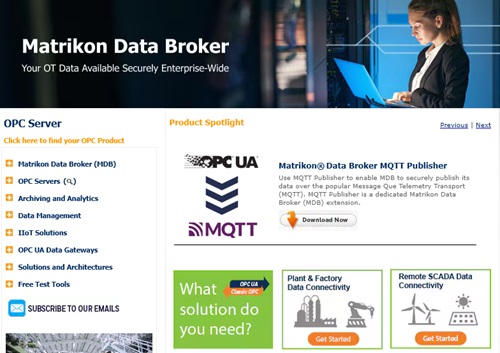
Source: Honeywell official website
https://www.matrikonopc.com/index.aspx
https://www.matrikonopc.com/index.aspx
MatrikonOPC ServerHoneywell
Integrate Field Data
into the Monitoring Network
into the Monitoring Network
Collects oil and gas drilling data via OPC. Secure transmission across firewalls and redundancy help maintain an audit-ready data foundation over time.
Quickly Check Who Did What,
and When
and When
All servers include diagnostic logging with log-level settings and filtering. The logs can also serve as a foundation for audit trails.
*Purchasing Site & Enterprise licenses requires an inquiry to
Velotic.